A leadership certification will not advance your career on its own. The right certification, from a recognised institution and applied to real work, genuinely can. It works when it closes a clear gap between where you are now and the role you want next, and when you can point to what changed in how you lead. It does very little when it is collected as one more line on a CV with nothing behind it.
Whether it advances your career depends on where you stand
There is no single answer, because a certification does different work at different stages.
Early career (0 to 5 years). Here a certification mostly does two useful things. It gives you a structured vocabulary for leadership before you have led much, and it signals seriousness to a hiring manager who cannot yet judge you on results. The value is real but modest. Treat it as a foundation, not a promotion trigger.
Mid-career or changing function (5 to 15 years). This is where the strongest case sits. If you are moving from an individual contributor role into managing people, or shifting from one function into a leadership seat in another, a recognised programme closes a credibility gap that experience alone cannot close quickly. It gives you frameworks to apply on Monday and a cohort of peers facing the same shift.
Senior leaders and CXOs. At this level the certificate itself matters least. What matters is the room you are in: the calibre of the cohort, the faculty, the exposure to problems outside your usual industry, and the network you leave with. Choose the programme for who is around the table, not for the line it adds to your profile.
Our honest view
A certification is an accelerant, not a cause. It speeds up a career that is already moving in the right direction, and it does almost nothing for one that is stationary. So we take a clear position: enrol when you can name the specific gap it will close and the decision or role it is meant to unlock. Do not enrol to feel productive, to wait out a plateau, or to collect credentials. The professionals who see real returns are the ones who apply the learning inside a live problem at work while the programme is still running, not months later.
What separates a certification worth doing from one that is not
Four things reliably tell you which side a programme falls on. A recognised institution, whose name carries weight with the people who decide your next role. An applied focus, with case studies, live projects and simulations, so you leave with something you have done, not only something you have heard. A real cohort of peers and mentors you keep after the programme ends, because the network often outlasts the content. And faculty with practical depth, people who have led, not only taught.
This is the bar WeSchool’s executive education is built to meet. Our Management Development Centre has delivered more than 45,000 hours of expertise across 7,600 training man-days, reaching over 6,200 participants including CXOs, drawn from more than 725 organisations including Fortune 500 firms. That track record is the difference between a certificate that signals something and one that does not.
Quick answers
Will a leadership certification get me a promotion?
Not by itself. It supports a promotion case that your results already justify. It is evidence, not a lever you pull on its own.
Is it worth the time and cost for a working professional?
Yes, when it is tied to a specific transition you are making now, and when the format lets you apply it while you learn. A weekend or modular schedule that fits around work removes most of the cost objection.
How do I choose between programmes?
Start from the role you want, work backwards to the gap, then pick the recognised, applied, cohort-based programme that closes it. Ignore programmes that cannot tell you who else will be in the room.
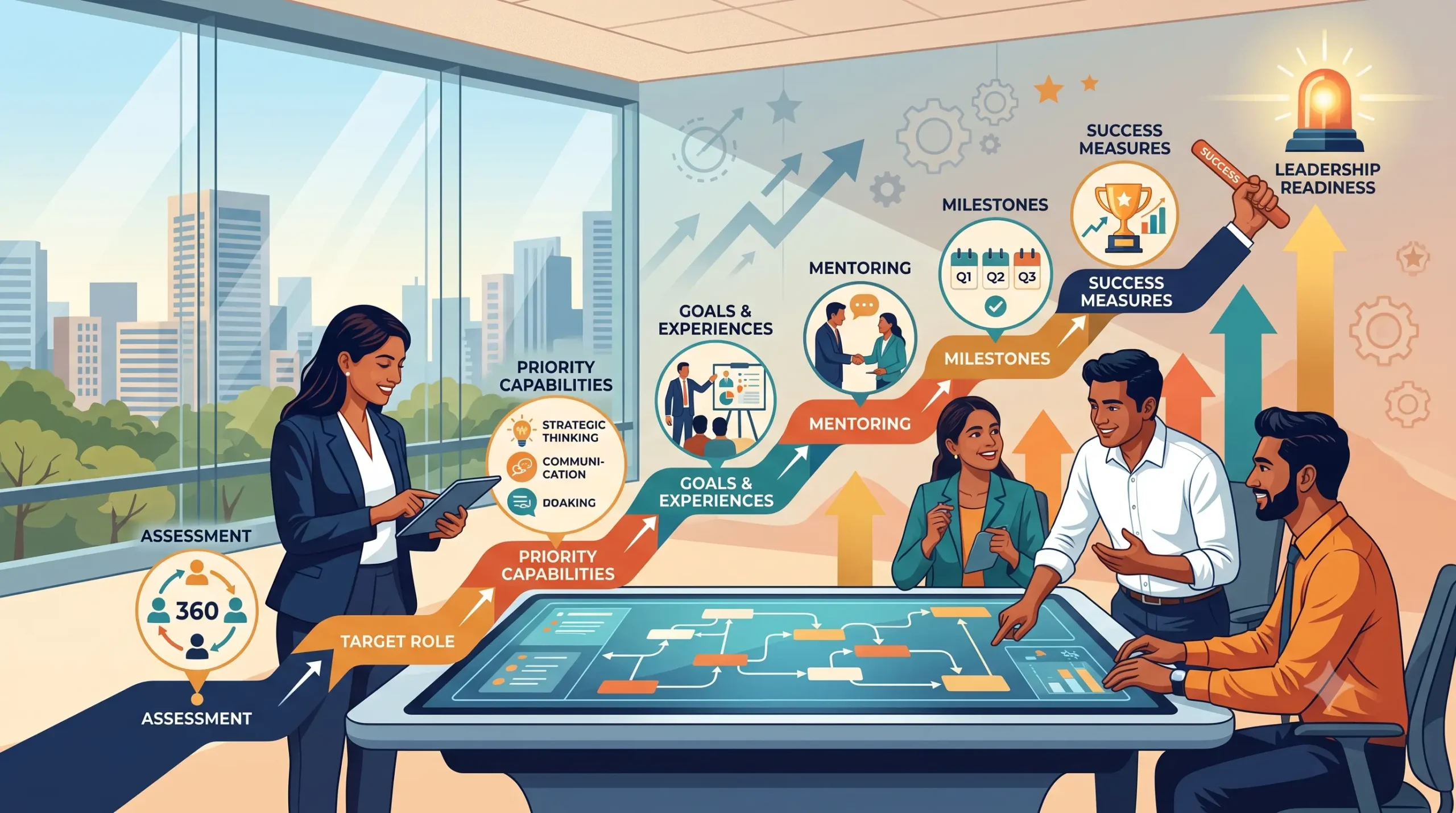
A leadership development plan is a structured roadmap that maps where a leader stands today against the capabilities they will need next, then defines the goals, experiences, mentoring, and timelines that close the gap. It works at two levels. An individual uses it to grow into a bigger role with intent instead of luck. An organisation uses it to build a reliable pipeline of leaders, rather than hoping the right person appears the moment a seat opens.
Here is the part most guides skip. A plan built around a list of courses is the single biggest reason so many leadership development plans quietly fail. The plans that actually change behaviour are built around real responsibility and live business challenges, with training used to accelerate growth, not to stand in for it.
This guide gives you both tracks. If you are building your own plan, start with Track 1. If you are an L&D or HR leader building plans for a team, go to Track 2. You also get a usable template, three worked examples set in Indian organisations, and a framework refined across our leadership development programme.
Leadership Development Plan vs Leadership Development Programme
These two are often confused, and getting them straight is what makes a plan work. A leadership development plan is the personal or team roadmap. It names the gap and the route to close it. A leadership development programme is the structured intervention, the mix of courses, coaching, assessments, and projects, that actually delivers the plan.
Put simply, the plan is the destination and the route. The programme is the vehicle. A plan with no programme behind it becomes a wish list. A programme with no plan behind it becomes training for its own sake. If you want the design detail of what goes into the vehicle, read our breakdown of the 12 core components of a successful leadership development programme.
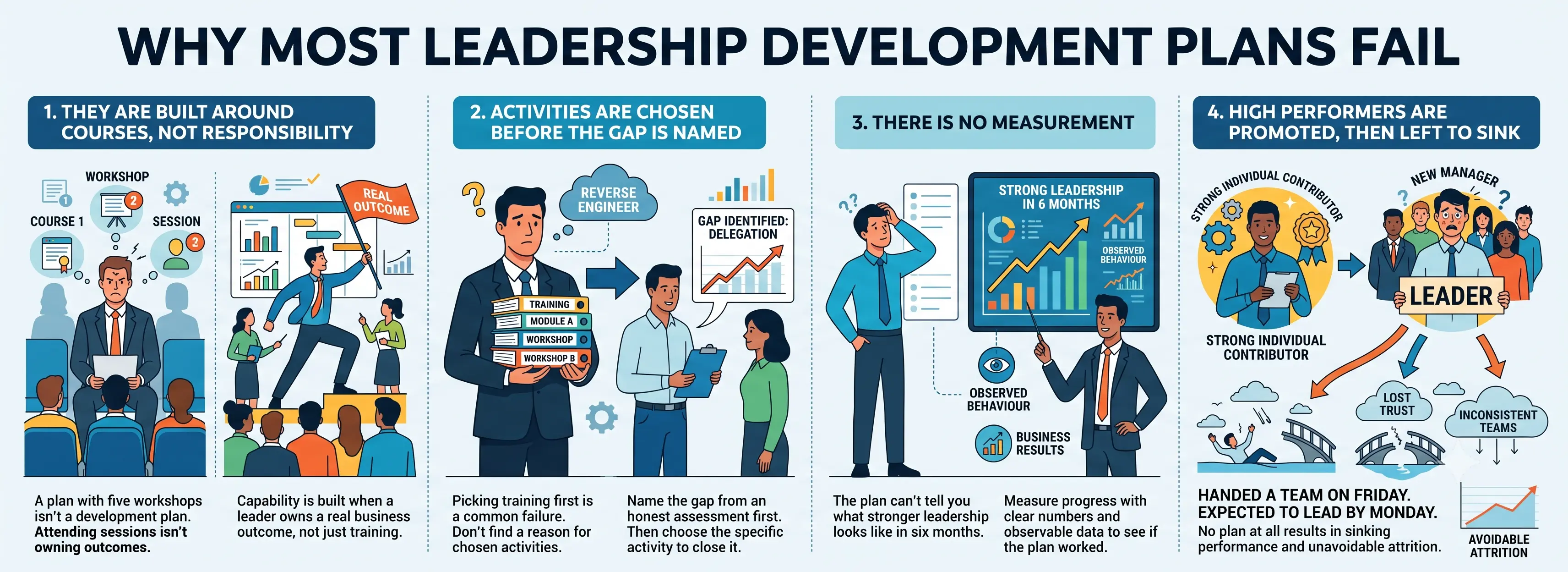
Why Most Leadership Development Plans Fail
Our position, after years of delivery across Indian organisations, is direct. Leadership gaps rarely come from a lack of talent. They come from a lack of structured development. Here is where plans break down.
They are built around courses, not responsibility: A plan that lists five workshops and calls itself a development plan has skipped the hard part. Capability is built when a leader owns a real outcome, not when they attend a session about owning outcomes.
Activities are chosen before the gap is named: The most common failure is picking the training first and reverse engineering a reason for it. Name the gap from an honest assessment, then choose the activity that closes it.
There is no measurement: If a plan cannot tell you what stronger leadership looks like in six months, in numbers or in observed behaviour, it cannot tell you whether it worked.
High performers are promoted, then left to sink: This is the Indian workplace pattern we see most often. A strong individual contributor is handed a team on a Friday and expected to lead by Monday, with no plan at all. The result is inconsistent teams, lost trust, and avoidable attrition.
Track 1: How to Build Your Own Leadership Development Plan
For the professional growing into a bigger role.
Name the target: Be specific about the role or level of leadership you are working towards, and roughly when. Vague ambition produces vague plans.
Get an honest baseline: Combine a self assessment with feedback from people around you, ideally a 360 degree review. You cannot close a gap you have not measured.
Pick three priority capabilities: Not ten. Choose the three that will most affect your readiness for the target role, such as strategic thinking, executive communication, or coaching others. Set goals tied to outcomes: Make each goal specific and measurable, and connect it to a real business result, not just a skill in the abstract.
Choose experiences first, training second: Lead a cross functional project, shadow a senior leader, or own a stretch outcome. Add courses to sharpen what the experience exposes.
Find a mentor or coach: Direction plus honest feedback is what turns reflection into change. Choose someone who has done the role you are aiming for.
Set milestones and review quarterly: Treat the plan as a living document. Revisit it every quarter, adjust, and keep momentum.
Track 2: How to Build Leadership Development Plans for Your Team
For the L&D or HR leader building a pipeline.
Identify who to develop: Focus on two groups: next in line leaders who will step up soon, and critical talent who are hard to replace. Development should be focused, not generic.
Secure stakeholder buy in: Leadership development fails when it is seen as an HR initiative rather than a business priority. Get visible sponsorship from senior leaders.
Define the behaviours your strategy needs: Decide what leadership must look like in your organisation, based on where the business is going, before you design any activity.
Baseline with assessment: Use 360 feedback, simulations, or structured reviews so plans are built on evidence, not reputation or tenure.
Map experiences: Stretch projects, cross functional exposure, and shadow boards build leaders faster than classroom time alone.
Layer structured training: Partner with a credible programme to bring frameworks, outside perspective, and CXO level context your internal sessions cannot.
Measure against business KPIs: Tie progress to retention, engagement, decision quality, or delivery, not to attendance. Review and refresh: Revisit plans on a set cadence so competencies stay matched to changing business needs.
Leadership Development Plan Template
Use this template to turn the steps above into a working document. Fill the final column from your assessment results, not from memory. Every goal should trace back to a specific finding. Leave the activities blank until the gap is named.
Component
What to fill in
Worked example: first-time manager
Target role or vision
The role or level of leadership you are building towards, and by when
Ready to lead a delivery team within 9 months
Current baseline
Strengths, gaps, and blind spots from self assessment and 360 feedback
Strong on delivery, weak on delegation and feedback, per 360 review
Priority capabilities
The three capabilities that matter most for the target
Coaching and feedback, prioritisation, stakeholder communication
Development goals
Specific, measurable goals linked to business outcomes
Run monthly feedback conversations and delegate two workstreams fully
Experiences and stretch assignments
Real responsibility that builds the capability through practice
Own sprint planning and retrospectives, mentor one junior engineer
Training and courses
Structured learning that accelerates the experience
A first time manager module
Mentor or coach
Who provides direction and honest feedback
An experienced team lead from another team
Milestones and timeline
Checkpoints and review dates to maintain momentum
Reviews at 3, 6, and 9 months
Success measures
What stronger leadership will look like, in behaviour and in numbers
Team delivering on time, improved 360 scores on delegation
Three Leadership Development Plan Examples
Three worked examples set in Indian organisations, showing what a plan looks like in practice at different levels.
Example 1: First-time manager, IT services
Goal: Shift from strong individual contributor to enabling team performance.
Capabilities: Coaching and feedback, prioritisation, stakeholder communication.
Experiences: Own sprint planning and retrospectives, run one performance conversation cycle with a junior team member, present updates to non technical stakeholders.
Training: A first time manager module to build the frameworks.
Timeframe: 9 months.
Example 2: Functional head to business head
Goal: Move from running a function to leading a business unit.
Capabilities: Strategic and commercial thinking, executive communication, enterprise decision making.
Experiences: Lead a cross functional initiative, shadow a business head, present a strategic proposal to the leadership team.
Goal: Build a ready succession pipeline for senior roles.
Capabilities: Talent identification, programme design, measurement against business KPIs.
Experiences: Map critical talent using a nine box view, set up a shadow board, run structured reviews.
Training: A partner led programme to bring CXO level context and outside perspective.
Timeframe: 12 months, reviewed quarterly.
How WeSchool Turns a Plan Into Capability
A plan names the gap. A programme closes it. This is where a plan built around real responsibility meets structured learning that actually accelerates growth. Our approach integrates management theory with applied learning and live business projects, so leaders build capability through practice and reflection, not classroom time alone.
That approach is backed by delivery at scale: 45,000+ hours of delivery expertise, 7,600+ training man-days, 6,200+ participants including CXOs, and 725+ organisations including Fortune 500 companies. If you are ready to move from a plan to a programme, our leadership development programme is built to do exactly that.
It is a structured roadmap that maps a leader’s current capabilities against the capabilities they need next, then defines the goals, experiences, mentoring, and timelines to close the gap. It can be built for an individual or for a whole team.
How do you write a leadership development plan?
Name the target role, take an honest baseline through self assessment and 360 feedback, pick three priority capabilities, set measurable goals tied to business outcomes, choose real experiences first and training second, add a mentor or coach, and set milestones you review each quarter.
What is the difference between a leadership development plan and a leadership programme?
The plan is the roadmap that names the gap and the route to close it. The programme is the structured intervention, the courses, coaching, and projects, that delivers the plan. You need both.
What should a leadership development plan include?
A target, a baseline assessment, priority capabilities, measurable goals, stretch experiences, supporting training, a mentor or coach, a timeline with milestones, and clear success measures.
Why do I need a personal leadership development plan?
Without one, growth is left to chance. A plan makes your development deliberate and measurable, so you build the specific capabilities your next role needs rather than hoping experience alone prepares you.
How long should a leadership development plan take?
Most plans run from 9 to 18 months depending on the size of the gap and the level of the role, with quarterly reviews to keep the plan alive and aligned to changing priorities.
The importance of leadership development is simple to state: it is the process of building the people who will run your organisation next, before you actually need them. When companies invest in it, they keep their best staff for longer, make better decisions under pressure, and always have someone ready to step up. When they ignore it, they lose good people, panic when a senior leader leaves, and hire expensive outsiders who do not understand the business. In India in 2026, where most organisations admit they do not have enough ready leaders, that gap is no longer a soft HR concern. It is a direct risk to growth.
This guide explains, in plain language, what leadership development means, why it matters more in India right now, and the nine concrete ways it pays back. It is written for professionals who want to grow, and for the HR, learning, and business leaders who decide where the training budget goes.
What does leadership development actually mean?
Leadership development is any planned effort to grow a person’s ability to lead others: to set direction, make decisions, influence people, and get results through a team rather than on their own. It is not one motivational talk or a single weekend workshop. It is a repeatable system of learning, practice, feedback, and mentoring that turns a good individual performer into someone others willingly follow.
If you are weighing up which leadership approach suits you, our guide to the different leadership styles every Indian manager should know breaks them down with real workplace examples.
Why the importance of leadership development is bigger in India right now
Here is the uncomfortable data. Recent global research from DDI’s 2025 Global Leadership Forecast, one of the largest leadership studies ever run, found that while most organisations say they prefer to promote from within, only about one in five HR leaders actually have successors ready for critical roles. Fewer than half of key positions could be filled internally if they opened up today. Across the world, roughly three in four organisations report a leadership gap, yet only around one in eight feel confident in their leadership programmes.
In India the picture is sharper for a specific reason: our economy is young, fast-growing, and heavily driven by family-run and founder-led businesses. Deloitte India data shows that a majority of next-generation leaders in Indian family enterprises step into the business before the age of 27. That means young leaders are being handed real responsibility early, often without a structured way to build the judgement that responsibility demands. Add rapid digital change and the arrival of AI into daily decision-making, and the skills that got today’s leaders promoted are not the skills tomorrow’s leaders will need.
This is our clear position, and we will not sit on the fence about it: most Indian companies still treat leadership development as an optional perk, a reward handed out when budgets are comfortable. That is the wrong mental model. Leadership development should be treated as core business infrastructure, like finance or IT. You would never run a growing company without a finance function and hope it works out. Running one without a deliberate way to build leaders is the same gamble, just slower to show its damage.
9 reasons the importance of leadership development shows up on the bottom line
Below are the nine benefits that matter most, each explained in plain terms with the business logic behind it.
It builds a leadership pipeline, so you are never caught out
A pipeline simply means having capable people ready to move up before a role falls vacant. When a senior leader resigns, retires, or is poached, an organisation with a pipeline promotes smoothly from within. One without a pipeline scrambles, hires an expensive outsider, and absorbs months of disruption while that person learns the ropes. Leadership development is how you build that bench quietly, in advance.
It keeps your best people from leaving
Talented professionals rarely leave for money alone. They leave when they stop growing. When a company visibly invests in developing its people, it signals a future worth staying for. Research consistently links strong leadership development cultures to higher employee satisfaction and better retention. Replacing a skilled employee can cost a large share of their annual salary once you count hiring, lost productivity, and onboarding, so retention is not a soft benefit. It is a direct saving.
It improves real business and financial performance
Good leaders make better calls, run tighter teams, and execute strategy more reliably. That shows up in numbers. Studies have repeatedly found that organisations with strong leadership and talent management deliver meaningfully higher shareholder returns than their peers. Great Place To Work India’s research similarly links strong leadership to a large rise in employees who feel their work has meaning, which feeds directly into productivity.
It helps you navigate change instead of being flattened by it
Markets shift, technology changes, and AI is now reshaping how decisions get made. Leading through change is arguably the single hardest part of any senior role. Leadership development builds the calm, the critical thinking, and the flexibility to steer a team through uncertainty rather than freeze. In a year where AI fluency has become a leadership requirement almost overnight, this is no longer a distant concern.
It turns managers into leaders
There is a real difference between a manager who keeps things running and a leader who takes people somewhere new. Development is the bridge between the two. This is exactly the journey we cover in our guide on moving from manager to leader with nine practical strategies, which shows how the shift actually happens in day-to-day work.
It sharpens decision-making under pressure
Leaders are paid to decide, often with incomplete information and a clock running. Good development trains people to weigh data, consider different viewpoints, judge risk, and then commit without dithering. In high-pressure sectors, one poor senior decision can cost far more than the entire training budget, which is why decision quality is one of the highest-return skills to build.
It strengthens the culture of the whole company
Culture is set at the top and copied downward. When leaders communicate well, give honest feedback, and treat people fairly, that behaviour spreads through the organisation. When they do not, that spreads too. Developing leaders is therefore one of the most powerful ways to improve company culture, because you are improving the people everyone else takes their cues from.
It develops future-ready, globally fluent leaders
Indian businesses increasingly work across borders, cultures, and time zones. Tomorrow’s leaders need more than local knowledge. They need cross-cultural awareness, digital confidence, and the ability to think in terms of whole systems rather than single departments. Structured development builds these deliberately, drawing on global best practice and real case studies rather than leaving them to chance.
It future-proofs founder-led and family businesses
This one matters especially in India. When leadership passes from a founder to the next generation or to professional management, the transition is where many otherwise healthy businesses stumble. Leadership development gives the incoming generation the structured judgement to carry the business forward, rather than relying purely on instinct or inherited authority. It is the difference between a smooth handover and a costly one.
The importance of leadership development changes depending on who you are
The same topic means different things to different readers, so it helps to be specific about occasion and intent.
If you are a professional or a new manager, the importance is personal. Leadership skill is what lets you take on bigger roles, lead confidently, and grow your career rather than plateau once the technical work is delegated to others.
If you are an HR or learning and development leader, the importance is strategic. You are the person who has to answer for the leadership gap when a critical role opens. A structured programme is your evidence-based way to close that gap and defend the budget with real outcomes.
If you are a founder or business owner, the importance is about continuity. Your business should be able to run and grow without every major decision routing through you. Developing leaders is how you build a company that outlasts your personal involvement.
If you are an aspiring CXO, the importance is about readiness. The jump from functional head to the C-suite demands strategic, human, and analytical skills that are rarely learned on the job alone. Deliberate development is how you arrive ready rather than hoping to learn on the way up.
How to actually start (not just agree that it matters)
Agreeing that leadership development is important is easy. Building it is where most organisations stall. A few grounded starting points:
Make sure the programme is tied to real business goals, not run as a standalone training event in a corner. This link between development and strategy is the single biggest predictor of whether it works, which we cover in how leadership development aligns with company strategy.
Finally, develop leaders at every level rather than only at the top. A simple way to structure this is the five levels of leadership framework, which maps how leadership capability grows stage by stage.
Where structured leadership development fits: the WeSchool view
We say all of this from direct experience, not theory. Welingkar Executive Education has delivered more than 45,000 hours of learning and 7,600 training man-days, working with over 6,200 participants including CXOs, across more than 725 organisations that include Fortune 500 names. That scale is precisely why we are confident about what does and does not build real leaders.
What we have seen is that leadership grows fastest when learning is applied, not just listened to. That is the principle behind our leadership development program, a four-month course built around live sessions with senior faculty, Harvard Business Review case studies, CXO Connect sessions with serving corporate leaders, and live project presentations judged by industry. Participants do not just study leadership. They practise it on real problems and get feedback from people who have led at the highest level.
To be transparent about expectations: no programme, ours included, turns someone into a great leader in four months on its own. What structured development does is compress years of trial and error into months, give people frameworks and judgement they would otherwise learn slowly and painfully, and connect them to leaders worth learning from. The growth after that still depends on the individual applying it. We would rather say that plainly than promise a transformation no honest programme can guarantee.
Frequently asked questions
Why is leadership development important?
Leadership development is important because it builds a ready supply of capable leaders, keeps talented employees from leaving, improves decision-making, and helps organisations navigate change. Without it, companies face leadership gaps, higher staff turnover, and disruption whenever a senior person leaves. It directly affects business performance, not just staff morale.
What is the main benefit of leadership development?
The single biggest benefit is a strong leadership pipeline: having people ready to step into senior roles before those roles fall vacant. This protects an organisation from disruption and reduces the need for expensive external hires who do not know the business.
Is leadership development worth the investment for smaller Indian companies?
Yes, and often more so. Smaller and founder-led companies are the most exposed when a key leader leaves, because responsibility is concentrated in fewer people. Building leadership depth early is how a growing business becomes able to scale beyond its founder.
How long does it take to develop a leader?
Leadership grows over years, but a structured programme of a few months can compress a lot of that learning by giving people frameworks, practice, and feedback they would otherwise acquire slowly. A focused course, such as a four-month executive programme, is best seen as an accelerator rather than a one-time fix.
What is the difference between management training and leadership development?
Management training teaches people to run processes, plans, and day-to-day operations. Leadership development builds the ability to set direction, influence people, and lead others through change. Most effective professionals need both, but leadership is the harder skill to build and the one that determines how far a career or a company can grow.
A leadership style is simply the way a manager guides a team, makes decisions, and motivates people to get work done. Put plainly, it is your default way of leading. The ten most common leadership styles every Indian manager should know are autocratic, democratic, laissez-faire,transformational, transactional, servant, coaching, charismatic, visionary and bureaucratic. No single style is the best one. The strongest leaders switch between them depending on the team, the task, and the situation in front of them.
Quick answer: The 10 leadership styles at a glance
Autocratic: the leader decides, the team follows.
Democratic: the leader invites input, then decides together.
Laissez-faire: the leader steps back and lets the team run.
Transformational: the leader inspires change around a bigger vision.
Transactional: the leader runs on clear targets, rewards and consequences.
Servant: the leader serves the team’s needs first.
Coaching: the leader develops each person’s skills over time.
Charismatic: the leader wins commitment through personal energy and belief.
Visionary: the leader paints a clear picture of the future and points the way.
Bureaucratic: the leader relies on rules, roles and set procedures.
The rest of this guide explains each style in plain English, shows when to use it, and gives real Indian business examples so you can spot the styles at work in companies you already know. We have written it for working professionals and managers, not for a textbook exam.
What is a leadership style?
A leadership style is the combined pattern of how a leader communicates, delegates work, makes decisions, and handles people. It is not one single action. It is the overall approach a manager brings to the job, day after day.
Most modern thinking on leadership styles traces back to three sources that are worth knowing, because they show this is a studied field and not just opinion. In the 1930s, the psychologist Kurt Lewin identified three basic styles: autocratic, democratic, and laissez-faire. Decades later, Daniel Goleman, writing in the Harvard Business Review, described six emotional leadership styles and argued that the best leaders use several of them, switching as needed. And the situational leadership model developed by Paul Hersey and Ken Blanchard made the same core point: the right style depends on how ready and skilled your team is. We will come back to that idea, because it matters more than memorising any single style.
Why leadership styles matter for Indian managers in 2026
Understanding leadership styles is not an academic exercise. It has a direct effect on whether your team stays engaged or quietly checks out. Recent workplace research points to a real problem in India. According to ADP Research’s People at Work 2025 report, employee engagement in India fell to 19 percent in 2025, down from 24 percent the year before, one of the sharpest drops recorded anywhere. When engagement falls, the leadership style at the top of the team is very often part of the story.
On top of that, the way we work has changed. Teams are hybrid, spread across cities, and increasingly working alongside artificial intelligence tools in daily tasks. A fixed, one-size-fits-all style struggles in that environment. A manager who can read the moment and adjust, firm when a deadline is burning, open when the team needs to think, has a genuine advantage. That flexibility is the real skill, and it is exactly what structured leadership development builds.
The 10 types of leadership styles, explained with examples
Autocratic leadership (also called authoritarian)
What it is: The leader makes the decisions and the team carries them out. There is little discussion or input from below.
Best used when: Speed matters and there is no time to debate, such as a crisis, a safety-critical factory floor, or a situation where the leader is the only person with the full picture.
Strength: Decisions are fast and expectations are crystal clear.
Watch-out: Used all the time, it drains motivation and makes capable people feel they have no voice. Steve Jobs at Apple is the example most often cited for tightly controlled, top-down decision making, which produced remarkable products but also intense pressure.
Democratic leadership (also called participative)
What it is: The leader asks the team for ideas and feedback, then makes the final call. Everyone gets heard, but the leader still owns the decision.
Best used when: The team is capable, the problem is complex, and you want buy-in and better ideas before committing.
Strength: Higher engagement, stronger commitment, and usually better decisions.
Watch-out: It is slower, and it can stall when a quick decision is needed. Ratan Tata is widely described as leading the Tata Group with a democratic and transformational blend, moving the group from a command structure towards a more distributed, team-based approach.
Laissez-faire leadership (also called delegative)
What it is: A hands-off style. Laissez-faire is a French phrase meaning “let them do”. The leader sets a direction, then steps back and lets the team decide how to get there.
Best used when: Your team is experienced, self-driven, and knows the work better than you do, for example senior researchers, designers, or specialist experts.
Strength: Freedom sparks creativity and ownership, and it frees the leader for bigger-picture work.
Watch-out: With a less experienced team it backfires fast, leading to confusion and dropped work. Hands-off is not the same as absent.
Transformational leadership
What it is: The leader inspires people to go beyond their day-to-day tasks by connecting the work to a larger, meaningful vision, and by growing people along the way.
Best used when: An organisation is changing, scaling, or needs to reinvent itself.
Strength: It lifts performance, drives innovation, and builds loyalty.
Watch-out: It is demanding to sustain and needs real emotional intelligence, which is the ability to read and manage emotions in yourself and others. N. R. Narayana Murthy of Infosys is a textbook Indian example, known for building the company around meritocracy, transparency, and ethics rather than command.
Transactional leadership
What it is: Leadership run on clear exchanges. Do the work, hit the target, get the reward. Miss it, and there is a consequence.
Best used when: Work is routine and measurable, such as sales floors, collections, manufacturing lines, or high-volume operations with defined targets.
Strength: It keeps output consistent and expectations unambiguous.
Watch-out: It rarely inspires anyone or builds long-term loyalty, because it treats people mainly through rewards and penalties.
Servant leadership
What it is: The leader puts the team’s growth and wellbeing first, and treats their own role as clearing obstacles so others can do their best work.
Best used when: You are building culture for the long term, or leading mission-driven and people-heavy organisations.
Strength: Deep trust, strong morale, and people who stay.
Watch-out: Taken too far, harmony can delay hard decisions. Kiran Mazumdar-Shaw of Biocon is often cited here for an empathetic, people-first approach paired with a strong sense of social responsibility.
Coaching leadership
What it is: The leader acts like a coach, spotting each person’s strengths and gaps, giving regular feedback, and stretching them with the right challenges.
Best used when: You are developing talent and playing a long game, not chasing a single quarter’s number.
Strength: It builds real capability and a bench of future leaders.
Watch-out: It is time-intensive and pays off slowly, which is exactly why it is so underused. Satya Nadella of Microsoft is the leading modern example, credited with shifting the culture from “know-it-all” to “learn-it-all”.
Charismatic leadership
What it is: The leader wins commitment through personal energy, conviction, and the ability to make people believe in a cause.
Best used when: Morale needs lifting, or a team needs rallying behind a difficult goal.
Strength: It creates energy and unity quickly.
Watch-out: When leadership leans too heavily on one personality, the organisation can wobble if that person leaves. The vision has to outlast the individual.
Visionary leadership
What it is: The leader paints a clear, compelling picture of where the organisation is going, then points everyone towards it.
Best used when: You are introducing a new direction, entering a new market, or starting something no one has done before.
Strength: It gives people direction and purpose during change.
Watch-out: Vision without follow-through is just a speech. It must be paired with execution. Kiran Mazumdar-Shaw again fits, having recognised the potential of biotechnology in India long before the market did, and building Biocon on that foresight.
Bureaucratic leadership
What it is: Leadership by rules, defined roles, and set procedures. The process is the priority.
Best used when: Consistency, safety, and compliance are non-negotiable, such as in banking, public sector organisations, and regulated industries.
Strength: Stability, fairness, and predictable outcomes.
Watch-out: It is slow to adapt and can smother creativity and quick problem-solving.
How to choose the right leadership style
Here is the honest truth that the listicles often skip: you do not pick one style for life. You choose the style that fits the person and the moment in front of you. A useful way to decide is to read three things before you lead:
The team’s readiness: A new or unsure team needs more direction, closer to autocratic or coaching. An expert, self-driven team needs space, closer to democratic or laissez-faire.
The task: A burning crisis calls for fast, top-down calls. A complex, open-ended problem rewards a democratic approach that pulls in more minds.
The stakes and time: When time is short and the cost of error is high, tighten up. When you are building for the long term, invest in coaching and servant approaches.
This is the situational leadership idea in practice. The manager does not change their values from one day to the next. They change their approach to match what the team and the task actually need.
Our view: Be situational, and stop underusing coaching
If you take one position from this guide, take this one. In 2026, the best Indian managers are not defined by a single favourite style. They are defined by how well they read a situation and switch. Rigidly “being an autocratic leader” or “being a democratic leader” is a weakness dressed up as an identity.
And if we had to name the single most underused high-value style in Indian workplaces right now, it is coaching. With engagement falling and younger professionals wanting growth more than instructions, the managers who invest time in developing their people will quietly outperform the ones who only chase this month’s targets. Coaching is slow, which is exactly why so few managers do it, and exactly why it is such an advantage for the ones who do. That is not a soft opinion. It is where the returns are.
From knowing the styles to leading with them
Reading about leadership styles is the easy part. Applying them under real pressure, with a real team and real targets, is where most managers get stuck. That gap between knowing and doing is what structured leadership development is built to close.
WeSchool’s Leadership Development Program is designed for exactly this. Ranked among India’s top private business schools, WeSchool combines management theory with live CXO Connect sessions, Harvard Business Review case studies, and live project presentations evaluated by industry experts. Rather than learning styles in the abstract, participants practise switching between them in real business scenarios, which is the skill that actually moves performance.
Why learn leadership at Welingkar Executive Education
Welingkar Executive Education brings 45,000 plus hours of delivery expertise, 7,600 plus training man-days, and 6,200 plus participants including CXOs across 725 plus organisations, including Fortune 500 companies. That is applied leadership learning, delivered by people who have trained the leaders you have heard of.
Frequently asked questions
What are the main types of leadership styles?
The main types of leadership styles are autocratic, democratic, laissez-faire, transformational, transactional, servant, coaching, charismatic, visionary, and bureaucratic. They differ mainly in how much control the leader keeps and how much they involve the team.
What is the most effective leadership style?
There is no single most effective leadership style. Research and practice both point to the same answer: the most effective leaders adjust their style to the situation, the task, and how ready their team is. Flexibility beats any one fixed style.
What are the three classic leadership styles?
The three classic leadership styles, identified by psychologist Kurt Lewin in the 1930s, are autocratic (the leader decides alone), democratic (the leader decides with the team), and laissez-faire (the leader lets the team decide). Most modern styles build on these three.
Ready to lead with the right style at the right time? Explore WeSchool’s Leadership Development Program and turn what you have just read into a skill you can use with your team.
Innovation is no longer limited to designers and entrepreneurs—it has become an essential skill for students preparing for the future. Whether pursuing engineering, business, management, or any other discipline, students are expected to think creatively, solve complex problems, and collaborate effectively. This is where aDesign Thinking Workshop for Students plays a vital role.
A design thinking workshop introduces students to a structured, human-centered approach to solving problems. Instead of focusing only on theories, it encourages participants to understand user needs, generate creative ideas, build prototypes, and test solutions. These practical skills help students become better innovators, leaders, and decision-makers in both academic and professional environments.
What Is Design Thinking?
Design thinking is a problem-solving methodology that focuses on understanding people before creating solutions. It combines creativity, empathy, critical thinking, and experimentation to address real-world challenges.
Unlike traditional approaches that jump directly to solutions, design thinking encourages students to first understand the problem from the user’s perspective. This results in more practical, innovative, and user-focused outcomes.
A Design Thinking Workshop helps participants apply these principles through interactive activities, brainstorming sessions, case studies, and collaborative projects.
Why Should Students Learn Design Thinking?
Today’s employers value professionals who can think beyond textbooks and develop innovative solutions. Participating in a Design Thinking Workshop for Students enables learners to build future-ready skills that are relevant across industries.
Some of the key benefits include:
Enhances creativity and innovation
Develops critical thinking skills
Improves teamwork and collaboration
Encourages empathy and user-centric thinking
Builds confidence in solving real-world problems
Strengthens communication and presentation skills
Prepares students for leadership roles
These skills are highly valued in startups, multinational companies, consulting firms, and entrepreneurial ventures.
The Five Stages of Design Thinking
Most Design Thinking Workshops follow a five-stage framework that guides participants from identifying a problem to creating effective solutions.
1. Empathize
The first step is understanding the needs, challenges, and experiences of the end user. Students conduct observations, interviews, or discussions to gather meaningful insights before proposing solutions.
2. Define
Once enough information has been collected, participants clearly define the problem they want to solve. A well-defined problem statement ensures the team focuses on the right challenge.
3. Ideate
This stage encourages brainstorming without limitations. Students generate multiple ideas, evaluate different possibilities, and explore innovative approaches before selecting the most suitable solution.
4. Prototype
Instead of spending months developing a final product, participants create simple prototypes or models to visualize their ideas quickly. This helps identify strengths and areas for improvement early in the process.
5. Test
The final stage involves gathering feedback from users and refining the solution. Testing helps students understand what works, what doesn’t, and how their ideas can be improved.
What Happens During a Design Thinking Workshop?
A typical Design Thinking Workshop for Students combines theory with hands-on learning. Rather than attending traditional lectures, participants actively engage in collaborative exercises that simulate real business and social challenges.
Activities often include:
Team-based problem-solving exercises
Brainstorming sessions
Customer journey mapping
Prototype development
Case study discussions
Innovation challenges
Group presentations
This practical approach helps students understand how creative ideas can be transformed into impactful solutions.
Skills Students Develop Through Design Thinking
A well-structured workshop focuses on developing both technical and interpersonal skills.
Some of the most valuable skills include:
Creative problem-solving
Critical thinking
Communication
Collaboration
Leadership
Decision-making
Innovation management
Adaptability
User research
Presentation skills
These competencies are useful not only in academics but also in internships, placements, entrepreneurship, and professional careers.
Why Design Thinking Matters for Future Careers
Organizations today seek professionals who can identify opportunities, solve business challenges, and create customer-focused solutions. Whether students aspire to become managers, entrepreneurs, consultants, product managers, or business analysts, design thinking provides a competitive advantage.
Professionals interested in expanding their strategic capabilities can also explore a Design Thinking Workshop in Bangalore, where they gain practical exposure to innovation frameworks, collaborative learning, and real-world business applications.
Students planning leadership careers can further strengthen their expertise by combining design thinking with a Leadership Development Program, helping them build confidence in leading teams and driving innovation.
Who Should Attend a Design Thinking Workshop?
A Design Thinking Workshop for Students is suitable for:
Undergraduate students
Postgraduate students
MBA aspirants
Engineering students
Management students
Entrepreneurs
Startup enthusiasts
Young professionals
No prior design experience is required. The workshop is designed for anyone who wants to improve their creative thinking and problem-solving abilities.
Conclusion
A Design Thinking Workshop for Students is more than just a creativity session—it’s an opportunity to develop practical skills that prepare learners for future academic and professional success. By learning to empathize with users, define problems, generate innovative ideas, build prototypes, and test solutions, students become confident problem-solvers capable of tackling real-world challenges.
As industries continue to value innovation and adaptability, investing in design thinking is an investment in long-term career growth. Through Welingkar Executive Development Programs, students can gain hands-on experience, learn from industry experts, and develop the mindset needed to thrive in today’s fast-changing world.
Frequently Asked Questions
1. What is a Design Thinking Workshop for Students?
It is an interactive learning program that teaches students a structured, human-centered approach to solving problems creatively and collaboratively.
2. Who can attend a Design Thinking Workshop?
Students from any academic background, including engineering, management, business, design, and science, can participate.
Yes. Design thinking helps students become more innovative and adaptable, making them valuable candidates across industries.
5. Why choose a Design Thinking Workshop in Bangalore?
Bangalore offers a vibrant innovation ecosystem, industry exposure, expert faculty, and opportunities to apply design thinking to real-world challenges.
Strong leadership is the foundation of every successful organization. As businesses navigate digital transformation, global competition, and evolving workforce expectations, developing capable leaders has become a strategic priority. Whether you’re an aspiring manager, a mid-level professional, or a senior executive, enrolling in a Leadership Development Program in Bangalore can help you build the skills needed to lead teams, drive innovation, and achieve business goals.
Bangalore is India’s innovation hub, making it an ideal destination for executive education. Institutions such as Welingkar Executive Development Programs offer industry-focused learning designed to help professionals strengthen leadership capabilities while balancing their careers.
Why Leadership Development Is More Important Than Ever
Organizations no longer look for managers who simply supervise teams. They seek leaders who can inspire people, solve complex business challenges, and make data-driven decisions. This is why investing in a Leadership Development Program is essential for both individuals and organizations.
Some key benefits include:
Improved strategic thinking
Better decision-making
Stronger communication and collaboration
Higher employee engagement
Increased organizational productivity
Better adaptability to change
Professionals who continuously upgrade their leadership skills are more likely to progress into senior management and executive roles.
How to Design an Effective Leadership Development Program
1. Define Leadership Competencies
Every successful leadership program begins by identifying the competencies required for business success. These may include emotional intelligence, strategic thinking, conflict resolution, coaching, communication, and decision-making.
Aligning these competencies with organizational goals ensures that leadership training delivers measurable business outcomes.
2. Create Learning Paths for Every Career Level
Leadership development should not follow a one-size-fits-all approach.
Early-career professionals should focus on communication, teamwork, and self-leadership.
Mid-level managers should develop coaching, delegation, and project leadership skills.
Senior executives should strengthen strategic leadership, innovation, and organizational transformation capabilities.
A well-designed Leadership Development Program in Bangalore provides customized learning experiences for professionals at every stage of their careers.
3. Integrate Business Strategy into Leadership
Great leaders understand how their decisions impact overall business performance. Combining leadership training with a Business Strategy Course helps professionals improve strategic planning, business growth, competitive positioning, and long-term decision-making.
This integrated approach prepares leaders to navigate uncertainty while driving sustainable organizational success.
4. Include Practical Learning Experiences
Leadership is best learned through experience rather than theory. Effective programs should include:
Business case studies
Leadership simulations
Executive coaching
Group projects
Peer-to-peer learning
Industry interactions
Practical exposure enables participants to apply leadership concepts to real business challenges.
5. Prepare Leaders for an AI-Driven Workplace
Technology is reshaping leadership. Modern managers must understand digital transformation, automation, and Artificial Intelligence to lead effectively.
Professionals can complement their leadership journey with an AI Course in Bangalore, gaining insights into how AI supports decision-making, innovation, and organizational efficiency.
6. Build Analytical Decision-Making Skills
Successful leaders rely on data as much as intuition. Understanding therole of business analyticsenables professionals to interpret workforce trends, customer insights, and operational performance more effectively.
Developing analytical thinking empowers leaders to make informed business decisions that support growth and improve organizational performance.
7. Measure Leadership Success
An effective leadership program should include continuous assessment. Organizations can evaluate success using metrics such as employee engagement, leadership effectiveness, team productivity, internal promotions, and business performance.
Regular feedback and coaching ensure continuous improvement while helping professionals translate learning into measurable results.
Essential Skills Every Leader Should Develop
Regardless of industry or experience level, every leader should build these essential competencies:
Strategic thinking
Emotional intelligence
Communication
Problem-solving
Critical thinking
Team management
Change management
Innovation
Business acumen
Coaching and mentoring
These capabilities enable professionals to lead confidently in today’s fast-changing business environment.
Why Executive Education Matters
Executive education helps bridge the gap between theory and practical application. An Executive Development Program equips professionals with leadership frameworks, real-world business insights, networking opportunities, and hands-on learning that can be applied immediately in the workplace.
For professionals planning long-term career growth, executive learning also complements programs such as an Executive MBA, creating a strong foundation for leadership and strategic decision-making.
Conclusion
Designing an effective Leadership Development Program in Bangalore requires a clear understanding of organizational goals, leadership competencies, and future business challenges. By combining strategic thinking, practical learning, digital capabilities, and analytical decision-making, organizations can build leaders who inspire teams and drive sustainable growth.
If you’re ready to advance your leadership journey, Welingkar Executive Development Programs offer industry-relevant learning experiences designed for professionals at every career stage. Whether your goal is to lead teams, manage transformation, or accelerate career growth, investing in leadership development is one of the smartest decisions you can make.
Frequently Asked Questions
1. Who should join a Leadership Development Program in Bangalore? It is ideal for aspiring managers, team leaders, mid-level professionals, senior executives, entrepreneurs, and business owners.
2. What skills are covered in leadership programs? Leadership programs focus on communication, strategic thinking, emotional intelligence, decision-making, change management, innovation, and team leadership.
3. Why is leadership development important? Leadership development improves organizational performance, employee engagement, decision-making, and long-term business growth.
Every successful business starts with a well-defined strategy. Whether you’re launching a startup, managing an established company, or planning your career in management, understanding what are the 7 types of business strategy can help you make informed decisions and achieve long-term growth.
In today’s competitive business environment, organizations need more than just a great product—they need a clear roadmap that aligns their goals, resources, and market opportunities. This is why professionals are increasingly enrolling in a business strategy courseto strengthen their decision-making and leadership capabilities.
If you’re looking to build strategic thinking skills, a business strategy course in Bangalore or an executive management program can provide practical knowledge through real-world business case studies and industry insights.
Why Is Business Strategy Important?
Understanding the importance of business strategy goes beyond planning. It enables businesses to identify opportunities, respond to market changes, and gain a competitive advantage.
A strong business strategy helps organizations:
Define long-term business goals
Improve decision-making
Allocate resources efficiently
Manage business risks
Increase profitability
Enhance customer satisfaction
Stay ahead of competitors
Companies that regularly review and refine their strategies are more likely to adapt to changing customer needs and economic conditions.
What Are the 7 Types of Business Strategy?
Here are the seven most commonly used business strategies that organizations adopt based on their objectives and market conditions.
1. Cost Leadership Strategy
A cost leadership strategy focuses on becoming the lowest-cost producer in the market while maintaining acceptable quality.
Businesses achieve this by:
Streamlining operations
Reducing production costs
Improving supply chain efficiency
Leveraging economies of scale
This strategy works best in highly competitive industries where price significantly influences customer purchasing decisions.
Example: Discount retailers and budget airlines.
2. Differentiation Strategy
A differentiation strategy aims to make products or services unique through innovation, quality, customer experience, or branding.
Companies using this strategy often invest in:
Product innovation
Premium quality
Customer service
Brand positioning
Technology
Customers are willing to pay more because they perceive greater value.
Example: Premium technology brands and luxury automobile manufacturers.
3. Focus Strategy
Instead of targeting the entire market, a focus strategy concentrates on a specific niche or customer segment.
Businesses may focus on:
Geographic markets
Customer demographics
Industry-specific solutions
Specialized products
This strategy helps businesses develop expertise and build stronger customer relationships.
4. Growth Strategy
Growth strategies are designed to expand market share, revenue, or business operations.
Common growth approaches include:
Market penetration
Product development
Market expansion
Business diversification
Strategic partnerships
Organizations often combine digital transformation with data-driven decision-making to accelerate growth.
5. Innovation Strategy
Innovation has become a key driver of business success.
An innovation strategy encourages businesses to:
Develop new products
Improve existing services
Adopt emerging technologies
Invest in research and development
Enhance customer experiences
Companies that embrace innovation remain competitive in rapidly evolving industries.
6. Customer-Centric Strategy
Modern businesses succeed by putting customers at the center of every decision.
This strategy focuses on:
Understanding customer behavior
Personalizing experiences
Building customer loyalty
Improving service quality
Increasing customer lifetime value
Organizations using customer-centric strategies often experience stronger brand loyalty and higher retention rates.
7. Digital Transformation Strategy
Technology is transforming every industry. A digital transformation strategy helps organizations leverage digital tools to improve efficiency and customer engagement.
Key initiatives include:
Automation
Artificial Intelligence (AI)
Data Analytics
Cloud Computing
Digital Marketing
Business Intelligence
Businesses that embrace digital transformation are better positioned for sustainable growth.
Skills Required for Marketing and Strategic Leadership
Business strategy and marketing go hand in hand. Professionals who understand both can create impactful business decisions.
Some of the essential skills required for marketing include:
Strategic thinking
Market research
Consumer behavior analysis
Data interpretation
Digital marketing
Brand management
Communication skills
Problem-solving
Leadership
Financial understanding
Project management
Negotiation
Decision-making
These skills enable professionals to identify market opportunities, understand customer needs, and execute successful marketing campaigns.
How a Business Strategy Course Can Help
A professional business strategy course equips learners with frameworks and tools to solve complex business challenges.
Participants typically learn:
Strategic planning
Competitive analysis
Business model innovation
Leadership development
Corporate strategy
Risk management
Performance measurement
Digital business strategies
Working professionals often choose executive education programs to enhance leadership capabilities while continuing their careers.
If you’re based in Karnataka, enrolling in a business strategy course in Bangalore offers access to experienced faculty, industry experts, networking opportunities, and practical learning through business simulations.
Who Should Learn Business Strategy?
Business strategy isn’t just for CEOs. It benefits professionals across industries.
Ideal learners include:
Business owners
Entrepreneurs
Marketing professionals
Product managers
Sales managers
Consultants
Project managers
Mid-level managers
Senior executives
MBA aspirants
Learning business strategy helps professionals make informed decisions that contribute to organizational success.
Why Executive Education Matters
The modern business landscape demands leaders who can think strategically, manage uncertainty, and drive innovation.
Executive education programs bridge the gap between academic knowledge and practical business application by focusing on real-world case studies, leadership development, and strategic decision-making.
For professionals aiming to advance into leadership roles, investing in continuous learning is no longer optional—it’s essential.
Conclusion
Understanding what are the 7 types of business strategy is essential for anyone looking to build a successful career in management or lead a growing business. From cost leadership and differentiation to innovation and digital transformation, each strategy serves a unique purpose depending on an organization’s goals and market conditions.
Equally important is developing the skills required for marketing, as strategic thinking and customer understanding are closely connected. Whether you’re an entrepreneur, manager, or aspiring business leader, enrolling in a business strategy course can help you gain practical knowledge, improve decision-making, and prepare for future leadership opportunities. If you’re seeking quality executive education, a business strategy course in Bangalore can provide the expertise, industry exposure, and strategic insights needed to excel in today’s competitive business environment.
Frequently Asked Questions
1. What are the 7 types of business strategy?
The seven major business strategies are Cost Leadership, Differentiation, Focus, Growth, Innovation, Customer-Centric, and Digital Transformation Strategy.
2. Why is business strategy important?
The importance of business strategy lies in helping organizations achieve long-term goals, improve efficiency, gain a competitive advantage, and adapt to market changes.
3. What skills are required for marketing professionals?
The essential skills required for marketing include strategic thinking, communication, digital marketing, analytics, customer research, leadership, creativity, and problem-solving.
4. Who should take a business strategy course?
Business owners, entrepreneurs, managers, marketing professionals, consultants, and aspiring leaders can benefit from a business strategy course.
Marketing is no longer just about creating advertisements or promoting products. In 2026, the skills required for marketing go far beyond creativity. Marketing professionals are expected to drive business growth, leverage emerging technologies, interpret customer data, and create meaningful brand experiences. As organizations embrace digital transformation and customer-centric strategies, developing future-ready marketing skills has become essential for long-term success.
Whether you’re an aspiring marketer, a mid-career professional, or a business leader, building the right marketing competencies is crucial for career growth. Employers today seek professionals who combine analytical thinking, creativity, leadership, and data-driven decision-making to deliver measurable business outcomes.
1. AI Literacy and Marketing Technology
Artificial Intelligence (AI) has become one of the essential marketing skills professionals need to stay competitive. From campaign automation and predictive analytics to content generation and personalization, AI is reshaping modern marketing.
Successful marketers don’t rely on automation alone—they understand how to use AI strategically while balancing technology with human creativity. As businesses continue investing in marketing technology, AI literacy has become one of the most valuable marketing capabilities across industries.
2. Data Analytics and Business Decision-Making
Modern marketing decisions are backed by data rather than assumptions. Understanding website analytics, campaign performance, customer behaviour, and ROI enables professionals to make smarter business decisions.
Developing strongmarketing analytics skills helps marketers optimize campaigns, improve customer experiences, and contribute directly to business growth. These core marketing skills make professionals valuable contributors across every industry.
3. Strategic Thinking and Customer-Centric Marketing
Marketing success depends on understanding customers as much as markets. Professionals who develop key marketing skills like strategic thinking, market research, customer journey mapping, and brand positioning help organizations build sustainable competitive advantages.
Strong professional marketing skills also enable marketers to solve business problems, anticipate changing consumer expectations, and support long-term business strategy.
4. Communication, Content, and Brand Storytelling
Communication remains one of the skills every marketer needs regardless of industry or experience level. Whether creating blogs, social media campaigns, videos, or email marketing content, effective storytelling strengthens brand credibility and customer trust.
Professionals who combine content creation with strategic communication develop stronger marketing competencies and become more effective business leaders.
5. Leadership, Adaptability, and Continuous Learning
The marketing landscape continues to evolve rapidly due to AI, digital transformation, and changing customer expectations. Professionals who embrace continuous learning develop future-ready marketing skills that prepare them for leadership positions.
Organizations increasingly seek individuals with strong leadership skills, adaptability, and strategic thinking to lead teams and manage organizational change.
Why Executive Education Is Essential for Marketing Professionals
Building the skills required for marketing doesn’t happen overnight. Continuous learning through executive education programmes helps professionals strengthen leadership capabilities, understand emerging technologies, and improve strategic decision-making.
Whether you’re interested in a marketing management programme, management education, or executive learning, structured programmes provide practical knowledge that supports long-term career growth.
Future-Proof Your Marketing Career
As marketing continues to evolve, professionals who develop the right marketing capabilities, marketing competencies, and future-ready marketing skills will be better positioned to lead digital transformation and create measurable business impact.
Investing in executive education programmes and continuous professional development enables marketers to stay ahead of marketing trends 2026, strengthen leadership abilities, and unlock new career opportunities.
Conclusion
The skills required for marketing in 2026 extend far beyond traditional advertising. Professionals must combine AI literacy, data analytics, strategic thinking, communication, and leadership to remain competitive in today’s business environment.
Developing these essential marketing skills through continuous learning and executive education helps professionals enhance their expertise, strengthen leadership capabilities, and accelerate long-term career growth.
Modern businesses no longer succeed by simply offering products or services. Today’s customers expect meaningful experiences, personalized solutions, innovation-driven interactions, and human-centered problem-solving. This shift has made the principles of design thinking: innovating with empathy one of the most valuable frameworks in business, education, technology, healthcare, entrepreneurship, and product development.
Organizations worldwide are embracing the principles of design thinking: innovating with empathy because traditional methods often fail to solve complex user problems effectively. Design thinking introduces a creative, collaborative, and empathy-driven process that helps businesses develop solutions people truly need.
At its core, the principles of design thinking: innovating with empathy focus on understanding human behavior, identifying pain points, generating innovative ideas, testing prototypes, and continuously improving outcomes. Unlike rigid problem-solving models, the design thinking approach encourages experimentation, creativity, and user-focused innovation.
The growing demand for innovation has increased the importance of the design thinking methodology across industries. From startups to multinational companies, organizations use design thinking to improve customer experiences, accelerate innovation, and create sustainable competitive advantages.
Whether you are an entrepreneur, business leader, student, designer, educator, or strategist, understanding the principles of design thinking: innovating with empathy can help you solve problems faster and build innovation-driven systems that create lasting impact.
This comprehensive guide explores the complete design thinking methodology, the 6 steps of design process, key design techniques, benefits, real-world applications, and how empathy fuels innovation in modern organizations.
What Is Design Thinking?
Design thinking is a human-centered innovation framework used to solve problems creatively and strategically. It focuses on understanding users deeply before developing solutions.
The foundation of the principles of design thinking: innovating with empathy lies in observing human behavior, identifying unmet needs, and creating solutions that improve experiences.
Unlike traditional analytical methods, the design thinking approach combines:
Creativity
Empathy
Experimentation
Collaboration
Innovation
Continuous learning
This process helps organizations create products, services, systems, and experiences that genuinely solve real-world problems.
Why Design Thinking Matters in Modern Innovation?
The business world is evolving rapidly. Organizations must continuously adapt to changing technologies, customer expectations, and market trends.
Traditional problem-solving often focuses heavily on logic and assumptions, while the principles of design thinking: innovating with empathy prioritize human needs and experiences.
Why Organizations Use Design Thinking
Better Customer Understanding
The design thinking methodology helps businesses understand customer emotions, frustrations, and motivations.
Faster Innovation
Creative experimentation accelerates idea generation and product development.
Improved Collaboration
Cross-functional teams work together more effectively.
Reduced Risk
Testing prototypes early minimizes costly mistakes.
Enhanced User Experience
Solutions become more practical and user-friendly.
These advantages explain why design thinking and innovation are becoming essential for long-term business growth.
The Principles of Design Thinking: Innovating With Empathy
Understanding the principles of design thinking: innovating with empathy is essential for applying this methodology successfully.
These principles guide how organizations approach creativity, innovation, and problem-solving.
Empathy Comes First
Empathy is the foundation of the entire design thinking process.
The concept of design thinking empathy focuses on understanding users emotionally and behaviorally.
Organizations must observe:
User frustrations
Customer motivations
Emotional experiences
Real-world challenges
Without empathy, innovation often becomes disconnected from actual human needs.
Why Empathy Matters
Builds Human-Centered Solutions
Products and services become more meaningful.
Improves Customer Experience
Understanding emotions leads to better interactions.
Reduces Assumptions
Businesses make decisions based on user insights rather than guesswork.
The success of the principles of design thinking: innovating with empathy depends heavily on empathy-driven research.
Focus on Problem Definition
Before solving any issue, organizations must clearly define the actual problem.
Many businesses fail because they solve symptoms instead of root causes.
The design thinking methodology encourages teams to ask:
What problem are we solving?
Who experiences this challenge?
Why does this issue exist?
What emotional impact does it create?
Clear problem definition improves innovation outcomes significantly.
Encourage Creative Ideation
Innovation requires creativity without fear of judgment.
One of the most important elements of the principles of design thinking: innovating with empathy is generating multiple possible solutions.
Teams brainstorm freely to explore innovative opportunities.
Popular Ideation Methods
Brainstorming
Mind Mapping
Crazy 8s
Storyboarding
Brainwriting
SCAMPER Method
These design techniques encourage diverse thinking and breakthrough innovation.
Build Prototypes Quickly
Instead of discussing ideas endlessly, organizations create simple prototypes for testing.
Prototypes may include:
Product mockups
User journey maps
Wireframes
Sketches
Interactive demos
The design thinking approach values action-oriented experimentation over perfection.
Test and Improve Continuously
Testing validates whether ideas actually solve user problems.
Feedback allows organizations to refine solutions repeatedly.
This iterative process is one reason why design thinking and innovation work effectively together.
Collaborate Across Teams
Innovation improves when people from different backgrounds collaborate.
Cross-functional teamwork combines:
Technical expertise
Creativity
Customer insights
Strategic thinking
The strongest innovations often emerge from collaborative environments.
What Are the Steps in a Design Process?
One of the most common questions people ask is: what are the steps in a design process?
The modern design thinking methodology generally follows six major stages.
The 6 Steps of Design Process
Empathize
The first step focuses on understanding users deeply.
Teams conduct:
Interviews
Observations
Surveys
User journey analysis
The goal is to identify emotional and functional pain points.
This stage strengthens design thinking empathy.
Define
The next step is clearly identifying the core problem.
Organizations summarize user insights into focused problem statements.
Example:
“How might we improve online learning engagement for students?”
This stage ensures innovation remains user-centered.
Ideate
Teams brainstorm multiple creative solutions.
The ideation phase encourages:
Open thinking
Wild ideas
Collaboration
Creative experimentation
The ideation stage is essential in the principles of design thinking: innovating with empathy.
Prototype
Ideas are transformed into simple, testable models.
Prototypes help organizations:
Visualize concepts
Gather feedback quickly
Reduce innovation risk
This practical experimentation accelerates learning.
Test
Users interact with prototypes and provide feedback.
Testing reveals:
Usability issues
Emotional reactions
Functional challenges
Improvement opportunities
Continuous refinement improves solution quality.
Implement
Successful solutions are launched and scaled.
Organizations monitor performance and continue improving based on user feedback.
These are the complete 6 steps of design process widely used in modern innovation frameworks.
Design Thinking Methodology Explained
The design thinking methodology combines creativity, strategy, empathy, and experimentation into one innovation framework.
Innovation today depends heavily on understanding human needs and emotional experiences.
This is why the principles of design thinking: innovating with empathy have become critical for modern business success.
Design and Innovation in Digital Transformation
Digital transformation requires more than technology adoption.
Organizations must redesign experiences around users.
The combination of design and innovation helps businesses create:
User-friendly digital platforms
Personalized customer experiences
Efficient workflows
Human-centered technologies
This integration improves both customer satisfaction and operational efficiency.
Challenges of Implementing Design Thinking
Although the benefits of design thinking are substantial, implementation can be challenging.
Common Challenges Include:
Resistance to Change
Traditional organizations may resist experimentation.
Fear of Failure
Employees may hesitate to share unconventional ideas.
Lack of Collaboration
Siloed departments reduce innovation quality.
Limited User Research
Insufficient empathy research weakens solutions.
Resource Constraints
Prototyping and testing require time and investment.
Organizations must build innovation-friendly cultures to overcome these challenges.
Future of Design Thinking
The future of the principles of design thinking: innovating with empathy will become even more important as industries evolve.
Emerging Trends
AI-Assisted Innovation
Artificial intelligence will support ideation and prototyping.
Data-Driven Design Thinking
Analytics will strengthen customer insights.
Remote Collaboration
Virtual innovation workshops will increase globally.
Sustainable Innovation
Organizations will prioritize environmentally responsible solutions.
Hyper-Personalized Experiences
Businesses will create highly customized user journeys.
The growing complexity of customer expectations ensures the continued importance of design thinking and innovation.
Design Thinking in Leadership and Organizational Culture
Modern leadership increasingly relies on empathy, adaptability, and innovation.
Leaders who understand the principles of design thinking: innovating with empathy build stronger organizations by encouraging:
Collaboration
Creativity
Continuous learning
Experimentation
Human-centered decision-making
Institutions like Wellingkar increasingly emphasize innovation-driven learning because modern industries require professionals who can solve complex challenges creatively.
Design Thinking Approach for Startups and Entrepreneurs
Startups operate in uncertain environments where rapid experimentation is critical.
The design thinking approach helps entrepreneurs:
Validate business ideas
Understand customer needs
Improve product-market fit
Reduce startup risks
Build scalable innovation models
This is why design thinking and innovation are central to entrepreneurial success today.
Design Thinking and Innovation for Long-Term Success
Organizations that embrace the principles of design thinking: innovating with empathy create stronger customer relationships, better products, and sustainable innovation cultures.
The integration of empathy, creativity, experimentation, and collaboration allows businesses to adapt faster in rapidly changing markets.
Whether applied in technology, healthcare, education, entrepreneurship, or corporate strategy, the design thinking methodology empowers organizations to solve complex problems while keeping human experiences at the center of innovation.
Companies and professionals who master design and innovation today will lead the future of business transformation tomorrow.
Frequently Asked Questions:
What are the principles of design thinking?
The main principles include empathy, problem definition, ideation, prototyping, testing, and collaboration.
What are the steps in a design process?
The 6 steps of design process are empathize, define, ideate, prototype, test, and implement.
What is the design thinking methodology?
The design thinking methodology is a human-centered innovation framework focused on empathy, creativity, experimentation, and iterative problem-solving.
What are the benefits of design thinking?
The major benefits of design thinking include better innovation, improved customer experience, faster problem-solving, collaboration, and reduced business risks.
What are the applications of design thinking?
The Applications of Design Thinking include healthcare, education, technology, retail, entrepreneurship, and business strategy.
How does design thinking improve innovation?
The connection between design thinking and innovation improves creativity, customer understanding, collaboration, and rapid experimentation.
What is the difference between design thinking and traditional problem solving?
Traditional methods focus on analysis and assumptions, while the design thinking approach focuses on empathy, experimentation, and user-centered innovation.
What are common design techniques used in design thinking?
Popular design techniques include brainstorming, prototyping, journey mapping, empathy mapping, storyboarding, and SCAMPER exercises.
Leadership development is no longer just an HR initiative. In 2026, it has become one of the most important business growth drivers for companies that want long-term success. Organizations invest millions in leadership training every year, yet many still struggle with poor execution, low employee engagement, leadership gaps, and disconnected business goals. The reason is simple: leadership development often fails because it is not aligned with company strategy. Understanding how leadership development aligns with company strategy helps organizations create leaders who can drive growth, improve decision-making, strengthen company culture, and support business transformation. When leadership development strategy is directly connected to organizational goals, companies experience:
Higher employee retention
Faster business execution
Better innovation
Stronger leadership alignment
Improved productivity
Sustainable growth
In this guide, you will learn:
Why leadership alignment matters
How leadership development supports business strategy
The leadership development strategic alignment process
Leadership development strategies that improve performance
The impact of leadership alignment in dual-role programs
Techniques and strategies to develop humility in leadership
Common mistakes companies should avoid
Let’s understand why modern organizations treat leadership development as a strategic business investment instead of a training activity.
What Is Leadership Development Alignment?
Leadership development alignment means designing leadership programs that directly support organizational goals, business priorities, and long-term company vision.
Instead of generic leadership workshops, businesses now create leadership development strategies based on:
Company growth plans
Market challenges
Employee expectations
Digital transformation
Organizational culture
Future leadership needs
This approach ensures that leaders are not only managing teams but also helping the company achieve strategic objectives.
Why Leadership Alignment Matters More Than Ever?
Companies today operate in rapidly changing business environments.
Organizations face:
AI-driven disruption
Remote workforce management
Economic uncertainty
Employee burnout
Competitive pressure
Fast-changing customer expectations
Because of this, businesses need leaders who can adapt quickly, communicate effectively, and align teams around organizational goals.
Without leadership alignment, companies often experience:
Problem
Business Impact
Poor communication
Reduced productivity
Leadership confusion
Slow execution
Misaligned priorities
Revenue loss
Weak employee engagement
High turnover
Lack of innovation
Competitive disadvantage
Strong leadership alignment helps organizations create consistency across teams and departments.
How Leadership Development Aligns With Company Strategy?
The connection between leadership development and business strategy is built around organizational goals. Companies first identify where they want to grow, then develop leaders who can support those objectives. For example:
Business Goal
Leadership Capability Needed
Digital transformation
Agile leadership
Market expansion
Strategic thinking
Employee retention
Emotional intelligence
Innovation
Collaborative leadership
Customer experience
Communication skills
Sustainability
Ethical leadership
This is how leadership development aligns with company strategy in practical business environments. Leadership development becomes effective only when it supports measurable business outcomes.
9 Leadership Development Strategies That Support Business Growth
Align Leadership Training With Business Goals
One of the biggest mistakes organizations make is running leadership programs without clear business objectives. Leadership development strategy should support:
Revenue growth
Innovation
Employee engagement
Operational efficiency
Customer satisfaction
When leadership programs match organizational priorities, companies see stronger results.
Build Future-Ready Leaders
Modern leaders need more than technical skills. Organizations now focus on:
Adaptability
Emotional intelligence
Strategic thinking
Change management
Collaboration
This leadership development approach prepares leaders for future business challenges.
Create Personalized Leadership Development Plans
Every leader has different strengths and skill gaps. Companies now use:
Leadership assessments
Coaching programs
Mentorship initiatives
Skill-based learning paths
Personalized learning improves leadership effectiveness and employee performance.
Strengthen Leadership Alignment Across Departments
Leadership alignment becomes stronger when departments work toward shared goals. Cross-functional leadership development strategies help leaders understand:
Finance
Marketing
Operations
HR
Technology
This improves communication and business execution.
Use Data to Improve Leadership Development
Organizations increasingly use analytics to measure leadership performance. Common leadership metrics include:
Employee retention
Productivity growth
Team engagement
Leadership readiness
Performance improvement
A data-driven leadership development strategic alignment process helps businesses optimize learning investments.
Encourage Continuous Learning
Leadership development should not be a one-time event. Successful organizations create ongoing learning cultures through:
Microlearning
Coaching
Workshops
Peer learning
Online leadership platforms
Continuous learning keeps leaders updated with changing business demands.
Focus on Emotional Intelligence
Employees today prefer leaders who are supportive, collaborative, and empathetic. Emotional intelligence improves:
Conflict management
Employee trust
Team communication
Workplace culture
This is why emotional intelligence is a major part of modern leadership development strategies.
Develop Ethical Leadership
Customers and employees expect businesses to act responsibly. Leadership development now includes:
Ethical decision-making
Diversity and inclusion
Sustainability
Corporate responsibility
Ethical leadership strengthens company reputation and long-term trust.
Build Agile Leadership Teams
Business environments change quickly. Organizations need leaders who can:
Adapt to uncertainty
Manage hybrid teams
Lead digital transformation
Respond to market shifts
Agility is now one of the most important leadership capabilities.
Leadership Development Strategy vs Traditional Leadership Training
Many organizations still confuse leadership development with traditional training programs.
Here is the difference:
Traditional Leadership Training
Strategic Leadership Development
Generic workshops
Business-focused learning
Short-term skill building
Long-term capability development
Limited personalization
Customized leadership pathways
HR-driven
Business-driven
Basic management skills
Strategic leadership competencies
Minimal performance tracking
KPI-based measurement
Organizations that understand how leadership development aligns with company strategy focus on long-term leadership capability rather than short-term training sessions.
Leadership Development Strategic Alignment Process
The leadership development strategic alignment process helps organizations connect leadership growth with business success.
Step 1: Define Business Priorities
Organizations identify strategic goals such as:
Market growth
Innovation
Workforce transformation
Customer experience
Step 2: Identify Leadership Competencies
Companies determine which leadership skills are needed to achieve those goals.
Step 3: Analyze Leadership Gaps
Businesses assess current leadership strengths and weaknesses through:
This creates a measurable and scalable leadership development strategy.
The Impact of Leadership Alignment in Dual-Role Programs
The impact of leadership alignment in dual-role programs is growing across modern organizations. Dual-role programs involve employees managing operational and strategic responsibilities at the same time.
Examples include:
Technical managers leading innovation initiatives
HR leaders driving digital transformation
Sales leaders managing strategic growth projects
Benefits of Leadership Alignment in Dual-Role Programs
Better Decision-Making
Aligned leaders make decisions that support both team and company goals.
Faster Strategic Execution
Employees understand how their daily responsibilities connect with organizational strategy.
Improved Collaboration
Cross-functional communication becomes more effective.
Stronger Accountability
Leaders take ownership of both operational and strategic outcomes.
Curriculum Leadership Strategies for Development and Implementation
Strong leadership development requires structured learning systems. Effective curriculum leadership strategies for development and implementation include:
Competency-Based Learning
Leadership training should focus on measurable business skills.
Industry-Specific Leadership Programs
Different industries require different leadership approaches. For example:
Healthcare requires empathy-focused leadership
Technology requires innovation-driven leadership
Retail requires customer-focused leadership
Blended Learning Models
Organizations combine:
Online training
Workshops
Mentorship
Coaching
Peer collaboration
This improves engagement and knowledge retention.
Techniques and Strategies to Develop Humility in Leadership
Humility is becoming one of the most valuable leadership qualities in modern workplaces. Employees trust leaders who are:
Self-aware
Authentic
Collaborative
Open to feedback
Best Techniques and Strategies to Develop Humility in Leadership
Encourage Self-Reflection
Leaders should regularly evaluate their behavior and decisions.
Organizations should recognize collaboration instead of individual ego-driven performance.
Support Mentorship Programs
Mentorship helps leaders remain grounded and connected with employees.
Common Leadership Development Mistakes Companies Make
Even large organizations struggle with leadership alignment because of these mistakes:
Using Generic Training Programs
Leadership development must match organizational goals and culture.
Ignoring Emerging Leaders
Companies often focus only on senior executives. Future leaders also need development opportunities.
Failing to Measure Leadership Impact
Without measurable KPIs, leadership programs lose effectiveness.
Treating Leadership Development as an HR Activity
Leadership development should involve business leaders, not only HR teams.
Future Trends in Leadership Development
Leadership development strategies are evolving rapidly.
AI-Powered Leadership Learning
AI helps personalize leadership training and track progress.
Human-Centered Leadership
Empathy and emotional intelligence will become even more important.
Remote Leadership Development
Virtual learning and remote coaching will continue growing.
Continuous Skill Development
Organizations will shift from annual training to continuous learning models.
Quick Answer: How Leadership Development Aligns With Company Strategy
Leadership development aligns with company strategy by preparing leaders to support organizational goals, improve employee performance, strengthen leadership alignment, and drive business growth. Companies achieve this by connecting leadership competencies, training programs, and performance metrics directly with strategic business objectives.
Frequently Asked Questions:
Why is leadership development important for organizational growth?
Leadership development helps organizations build leaders who can improve employee engagement, manage change, support innovation, and execute business strategy effectively.
What is leadership alignment?
Leadership alignment ensures leaders across departments work toward shared organizational goals and strategic priorities.
What is a leadership development strategic alignment process?
It is the process of connecting leadership training, competencies, and performance metrics directly with business objectives.
What are the best leadership development strategies?
The best leadership development strategies include personalized learning, emotional intelligence training, agile leadership development, coaching, mentorship, and continuous learning programs.
What are the techniques and strategies to develop humility in leadership?
Effective techniques include self-reflection, mentorship, active listening, collaborative leadership, and continuous feedback systems.
How does leadership alignment improve business performance?
Developing a Leadership Strategy for Long-Term Success
Organizations that prioritize developing a leadership strategy gain a significant competitive advantage in today’s business environment. Leadership is no longer only about managing teams. Modern leaders must support innovation, improve employee experiences, drive transformation, and align organizational efforts around long-term business goals. Companies that invest in leadership alignment and strategic leadership development create stronger cultures, better decision-making systems, and sustainable business growth. The future belongs to organizations that build leaders capable of adapting, collaborating, and executing strategy effectively.