
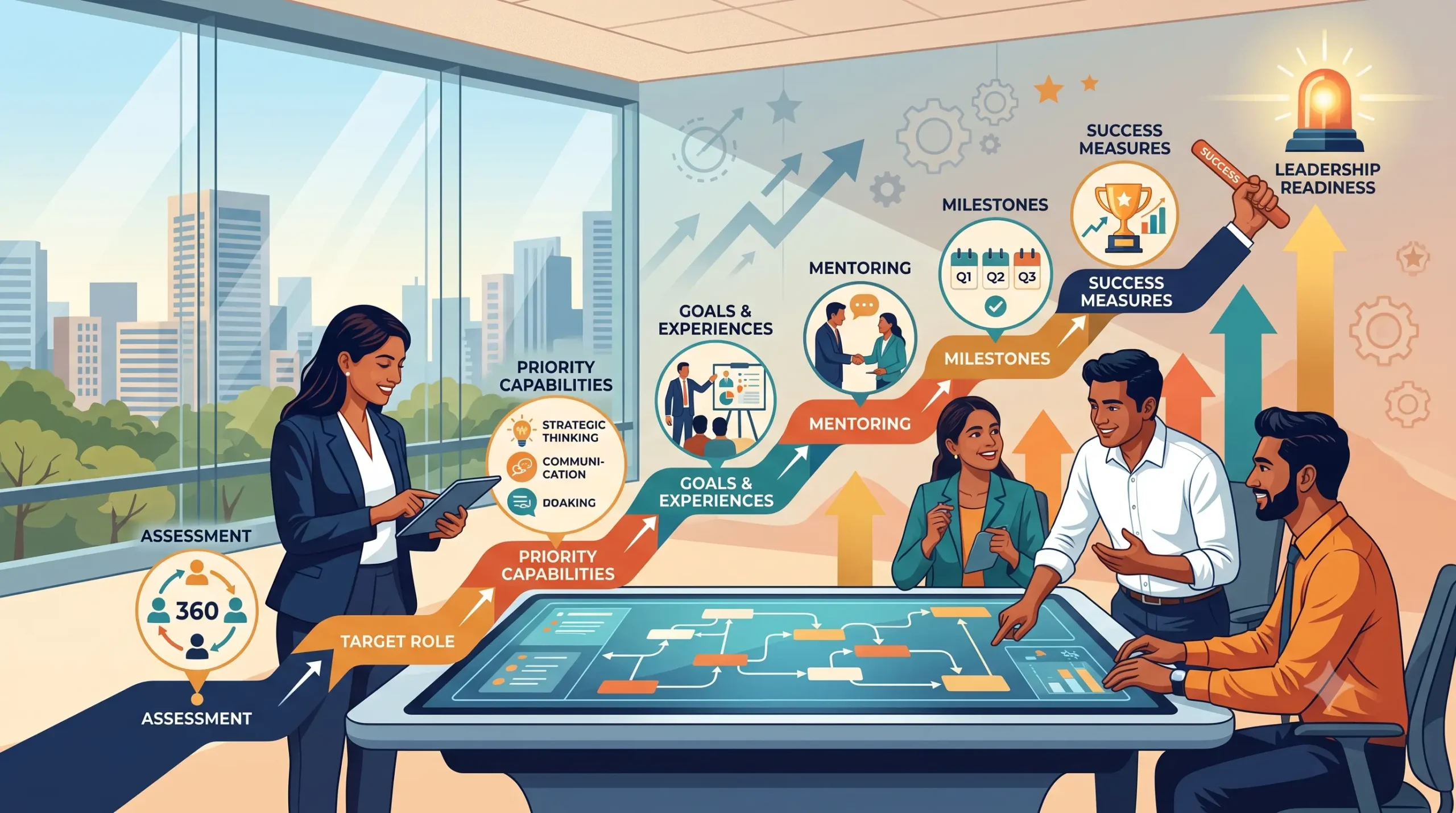
A leadership development plan is a structured roadmap that maps where a leader stands today against the capabilities they will need next, then defines the goals, experiences, mentoring, and timelines that close the gap. It works at two levels. An individual uses it to grow into a bigger role with intent instead of luck. An organisation uses it to build a reliable pipeline of leaders, rather than hoping the right person appears the moment a seat opens.
Here is the part most guides skip. A plan built around a list of courses is the single biggest reason so many leadership development plans quietly fail. The plans that actually change behaviour are built around real responsibility and live business challenges, with training used to accelerate growth, not to stand in for it.
This guide gives you both tracks. If you are building your own plan, start with Track 1. If you are an L&D or HR leader building plans for a team, go to Track 2. You also get a usable template, three worked examples set in Indian organisations, and a framework refined across our leadership development programme.
Leadership Development Plan vs Leadership Development Programme
These two are often confused, and getting them straight is what makes a plan work. A leadership development plan is the personal or team roadmap. It names the gap and the route to close it. A leadership development programme is the structured intervention, the mix of courses, coaching, assessments, and projects, that actually delivers the plan.
Put simply, the plan is the destination and the route. The programme is the vehicle. A plan with no programme behind it becomes a wish list. A programme with no plan behind it becomes training for its own sake. If you want the design detail of what goes into the vehicle, read our breakdown of the 12 core components of a successful leadership development programme.
Why Most Leadership Development Plans Fail
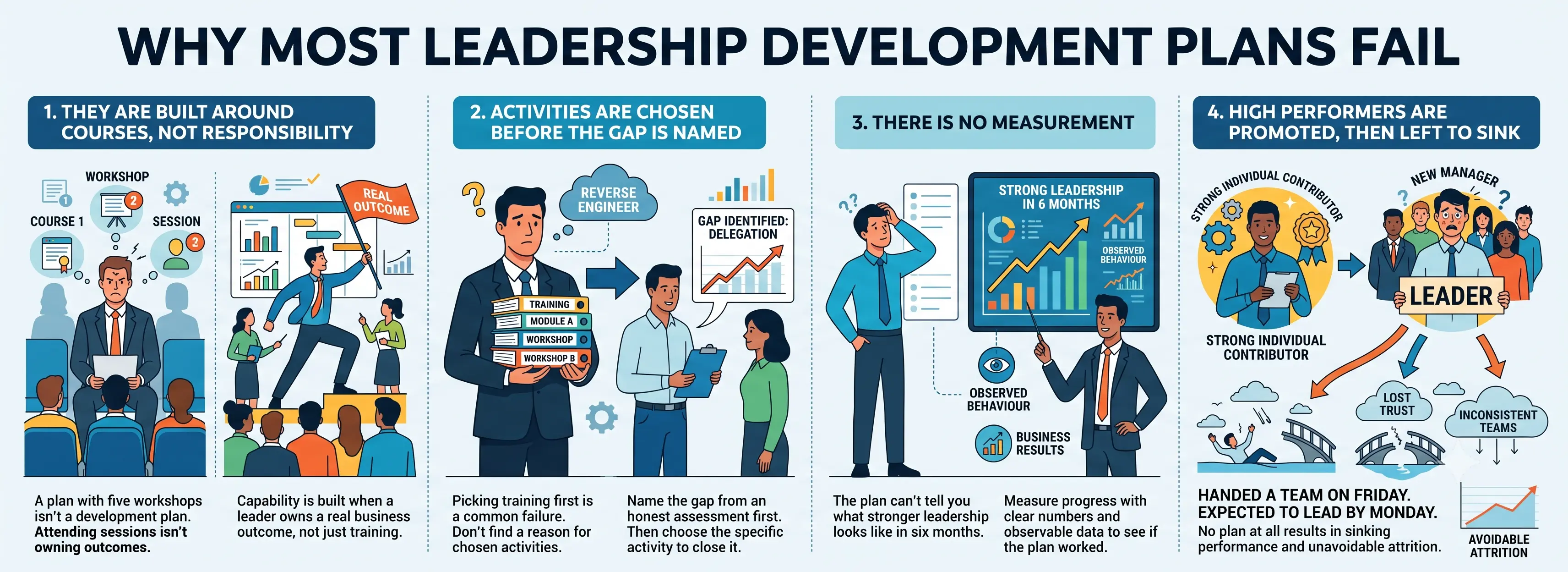
Our position, after years of delivery across Indian organisations, is direct. Leadership gaps rarely come from a lack of talent. They come from a lack of structured development. Here is where plans break down.
They are built around courses, not responsibility: A plan that lists five workshops and calls itself a development plan has skipped the hard part. Capability is built when a leader owns a real outcome, not when they attend a session about owning outcomes.
Activities are chosen before the gap is named: The most common failure is picking the training first and reverse engineering a reason for it. Name the gap from an honest assessment, then choose the activity that closes it.
There is no measurement: If a plan cannot tell you what stronger leadership looks like in six months, in numbers or in observed behaviour, it cannot tell you whether it worked.
High performers are promoted, then left to sink: This is the Indian workplace pattern we see most often. A strong individual contributor is handed a team on a Friday and expected to lead by Monday, with no plan at all. The result is inconsistent teams, lost trust, and avoidable attrition.
Track 1: How to Build Your Own Leadership Development Plan
For the professional growing into a bigger role.
- Name the target: Be specific about the role or level of leadership you are working towards, and roughly when. Vague ambition produces vague plans.
- Get an honest baseline: Combine a self assessment with feedback from people around you, ideally a 360 degree review. You cannot close a gap you have not measured.
- Pick three priority capabilities: Not ten. Choose the three that will most affect your readiness for the target role, such as strategic thinking, executive communication, or coaching others.
Set goals tied to outcomes: Make each goal specific and measurable, and connect it to a real business result, not just a skill in the abstract. - Choose experiences first, training second: Lead a cross functional project, shadow a senior leader, or own a stretch outcome. Add courses to sharpen what the experience exposes.
- Find a mentor or coach: Direction plus honest feedback is what turns reflection into change. Choose someone who has done the role you are aiming for.
- Set milestones and review quarterly: Treat the plan as a living document. Revisit it every quarter, adjust, and keep momentum.
Track 2: How to Build Leadership Development Plans for Your Team
For the L&D or HR leader building a pipeline.
- Identify who to develop: Focus on two groups: next in line leaders who will step up soon, and critical talent who are hard to replace. Development should be focused, not generic.
- Secure stakeholder buy in: Leadership development fails when it is seen as an HR initiative rather than a business priority. Get visible sponsorship from senior leaders.
- Define the behaviours your strategy needs: Decide what leadership must look like in your organisation, based on where the business is going, before you design any activity.
- Baseline with assessment: Use 360 feedback, simulations, or structured reviews so plans are built on evidence, not reputation or tenure.
- Map experiences: Stretch projects, cross functional exposure, and shadow boards build leaders faster than classroom time alone.
- Layer structured training: Partner with a credible programme to bring frameworks, outside perspective, and CXO level context your internal sessions cannot.
- Measure against business KPIs: Tie progress to retention, engagement, decision quality, or delivery, not to attendance.
Review and refresh: Revisit plans on a set cadence so competencies stay matched to changing business needs.
Leadership Development Plan Template
Use this template to turn the steps above into a working document. Fill the final column from your assessment results, not from memory. Every goal should trace back to a specific finding. Leave the activities blank until the gap is named.
| Component | What to fill in | Worked example: first-time manager |
| Target role or vision | The role or level of leadership you are building towards, and by when | Ready to lead a delivery team within 9 months |
| Current baseline | Strengths, gaps, and blind spots from self assessment and 360 feedback | Strong on delivery, weak on delegation and feedback, per 360 review |
| Priority capabilities | The three capabilities that matter most for the target | Coaching and feedback, prioritisation, stakeholder communication |
| Development goals | Specific, measurable goals linked to business outcomes | Run monthly feedback conversations and delegate two workstreams fully |
| Experiences and stretch assignments | Real responsibility that builds the capability through practice | Own sprint planning and retrospectives, mentor one junior engineer |
| Training and courses | Structured learning that accelerates the experience | A first time manager module |
| Mentor or coach | Who provides direction and honest feedback | An experienced team lead from another team |
| Milestones and timeline | Checkpoints and review dates to maintain momentum | Reviews at 3, 6, and 9 months |
| Success measures | What stronger leadership will look like, in behaviour and in numbers | Team delivering on time, improved 360 scores on delegation |
Three Leadership Development Plan Examples
Three worked examples set in Indian organisations, showing what a plan looks like in practice at different levels.
Example 1: First-time manager, IT services
- Goal: Shift from strong individual contributor to enabling team performance.
- Capabilities: Coaching and feedback, prioritisation, stakeholder communication.
- Experiences: Own sprint planning and retrospectives, run one performance conversation cycle with a junior team member, present updates to non technical stakeholders.
- Training: A first time manager module to build the frameworks.
- Timeframe: 9 months.
Example 2: Functional head to business head
- Goal: Move from running a function to leading a business unit.
- Capabilities: Strategic and commercial thinking, executive communication, enterprise decision making.
- Experiences: Lead a cross functional initiative, shadow a business head, present a strategic proposal to the leadership team.
- Training: Targeted commercial training and executive coaching. See our executive leadership development track.
- Timeframe: 12 to 18 months.
Example 3: L&D leader, CXO pipeline
- Goal: Build a ready succession pipeline for senior roles.
- Capabilities: Talent identification, programme design, measurement against business KPIs.
- Experiences: Map critical talent using a nine box view, set up a shadow board, run structured reviews.
- Training: A partner led programme to bring CXO level context and outside perspective.
- Timeframe: 12 months, reviewed quarterly.
How WeSchool Turns a Plan Into Capability
A plan names the gap. A programme closes it. This is where a plan built around real responsibility meets structured learning that actually accelerates growth. Our approach integrates management theory with applied learning and live business projects, so leaders build capability through practice and reflection, not classroom time alone.
That approach is backed by delivery at scale: 45,000+ hours of delivery expertise, 7,600+ training man-days, 6,200+ participants including CXOs, and 725+ organisations including Fortune 500 companies. If you are ready to move from a plan to a programme, our leadership development programme is built to do exactly that.
Explore the leadership development programme →
Frequently Asked Questions
It is a structured roadmap that maps a leader’s current capabilities against the capabilities they need next, then defines the goals, experiences, mentoring, and timelines to close the gap. It can be built for an individual or for a whole team.
Name the target role, take an honest baseline through self assessment and 360 feedback, pick three priority capabilities, set measurable goals tied to business outcomes, choose real experiences first and training second, add a mentor or coach, and set milestones you review each quarter.
The plan is the roadmap that names the gap and the route to close it. The programme is the structured intervention, the courses, coaching, and projects, that delivers the plan. You need both.
A target, a baseline assessment, priority capabilities, measurable goals, stretch experiences, supporting training, a mentor or coach, a timeline with milestones, and clear success measures.
Without one, growth is left to chance. A plan makes your development deliberate and measurable, so you build the specific capabilities your next role needs rather than hoping experience alone prepares you.
Most plans run from 9 to 18 months depending on the size of the gap and the level of the role, with quarterly reviews to keep the plan alive and aligned to changing priorities.
2 thoughts on “What Is a Leadership Development Plan?”